Diving the Great Barrier Reef: Requirements and Costs
Certification or intro dive, medical declaration, marine park charge, stinger season and rough prices: what you need to dive the Great Barrier Reef.
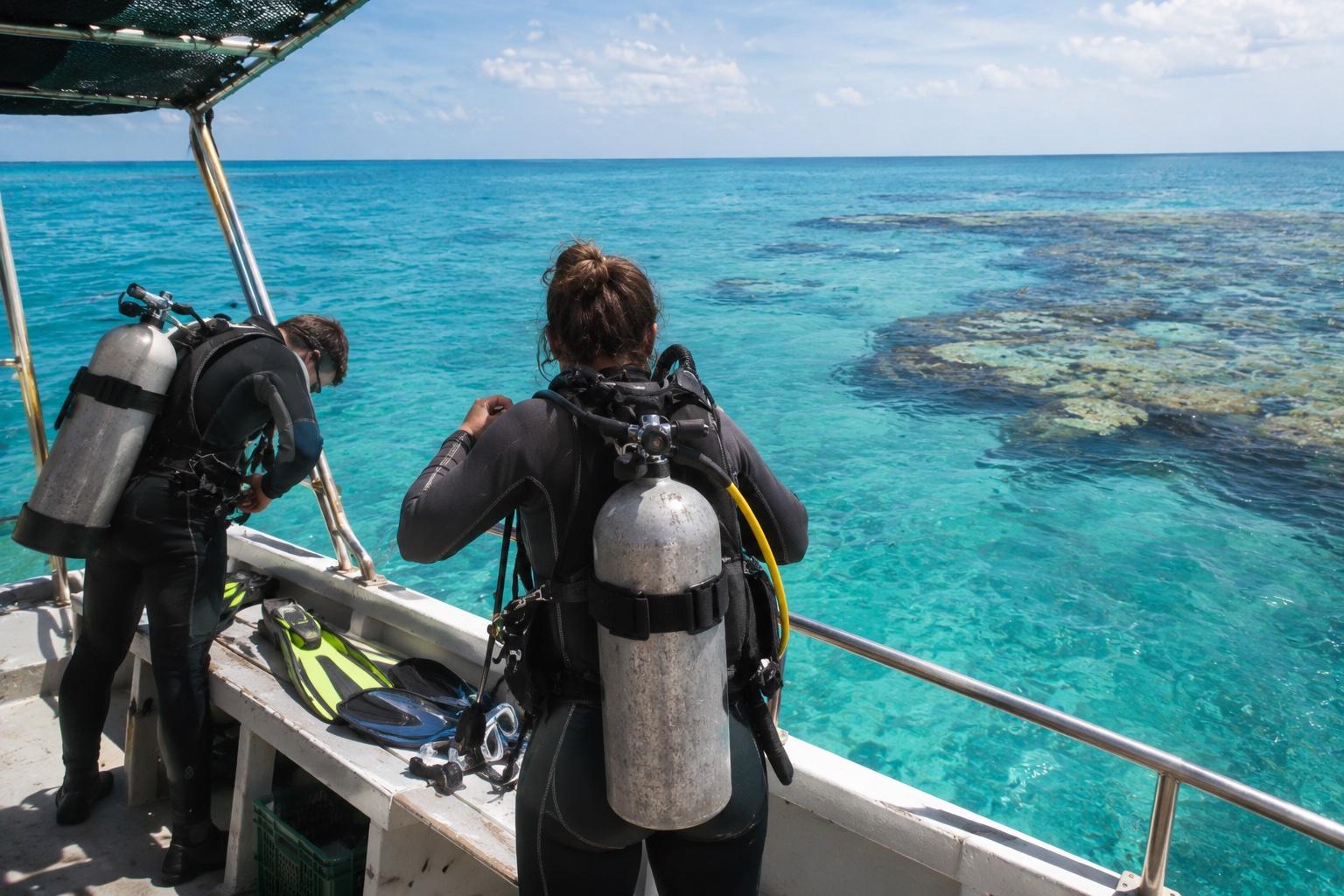
You don't need a certification to dive the Great Barrier Reef. An introductory dive with an instructor gets you underwater on day one. What every operator will ask for is a signed medical declaration, and depending on your answers, a doctor's clearance. Most trips leave from Cairns, Port Douglas or Airlie Beach in the Whitsundays, include a small daily marine park charge and, from November to May, you'll dive in a full-body stinger suit.
- No certification
- Introductory dive with instructor
- Paperwork
- Medical declaration required
- Marine park charge (EMC)
- AUD 8.50 per full day
- Stinger season
- November to May
- Day trip with intro dive
- About AUD 275 to 500
Do you need to be certified to dive the Great Barrier Reef?
No. You have three routes depending on experience.
Introductory dive
Formerly called a "resort dive", Queensland's rules now call it a "non-certified dive". You go down with an instructor, at shallow depth, after a briefing and a few basic skills. Many day boats sell it as an add-on to a snorkel trip. Some operators set a minimum age, such as 12, so check if you're travelling with kids.
Open Water course
If you want to come home certified, Cairns is one of the most common places to do it. Four and five-day courses mix theory, pool sessions and reef dives. Courses with nights on a liveaboard boat give you more ocean dives.
Certified divers
Bring your certification card (physical or in your agency's app) and your logbook. That's enough to book guided or buddy dives, depending on the operator.
Medical declaration: what you'll be asked for
Queensland brought in a new regulation and code of practice for recreational diving on 1 August 2024. For visitors, the key change is this:
- Before an introductory dive or a course you fill in a medical declaration on the approved form. For entry-level divers, that form is the UHMS diver medical questionnaire.
- If you answer no to everything, you can dive.
- If you tick a box that triggers an evaluation, such as certain breathing or heart conditions, you need a doctor to clear you before getting in the water.
Practical tip: download the questionnaire before you leave home. If anything on it applies to you, get your own doctor to sign you off in advance. Sorting it out on the wharf at 7 am is hard.
Where to base yourself: Cairns, Port Douglas or the Whitsundays
All three have day-trip dive operators and liveaboards.
| Base | Best for |
|---|---|
| Cairns | Widest choice of boats, courses and prices. International airport. |
| Port Douglas | Smaller town, about 67 km (an hour's drive) north of Cairns. |
| Airlie Beach (Whitsundays) | Combining diving with sailing the Whitsunday Islands. |
If it's your first time and you only have a few days, Cairns has the most daily departures and courses.
The marine park charge (EMC)
Every visitor who enters the Marine Park with a tourism operator pays the Environmental Management Charge (EMC). The operator collects it and the Great Barrier Reef Marine Park Authority (GBRMPA) puts it toward managing the reef.
GBRMPA says the full-day rate rises by AUD 0.50 to AUD 9.00 from 1 April 2027. That puts the current rate at AUD 8.50 for a full day and AUD 4.25 for a part day. Multi-day trips have a per-person cap. Some operators include it in the price and others add it at checkout, so read the breakdown when you book.
Best time to go and stinger season
When to go
Tourism Australia names May to October as a great time: the water is still warm enough to swim and visibility is at its best. Queensland's tourism body agrees that May to October is peak season with the least rain, and also points to strong water clarity from November to April. In winter the water sits around 24°C and boats hand out wetsuits.
Stingers
The Queensland Government puts marine stinger season at November to May. Stingers are in tropical waters all year, but the risk is higher in those months. The two species that matter are the box jellyfish and the Irukandji, and both can deliver a fatal sting.
Your main protection is a full-body lycra or neoprene suit. Boats rent them or include them. Stinger nets at some beaches keep box jellyfish out, but Irukandji are small enough to get through, so you still need the suit.
How much does diving the Great Barrier Reef cost?
Rough prices in Australian dollars, checked in November 2026 on Cairns operator and reseller websites. They change with the season and with what's included (gear, transfers, lunch, charges).
| Option | Rough range |
|---|---|
| Day trip with 1 introductory dive | AUD 275 to 375 |
| Day trip with 2 or 3 introductory dives | AUD 435 to 500 |
| Extra certified dive on a day trip | AUD 50 to 100 |
| 4-day Open Water course with day trips | from about AUD 945 |
| 4 to 5-day Open Water course with liveaboard nights | AUD 1,235 to 1,420 |
Watch the extras. Some liveaboard courses add the marine park charge or a fuel surcharge on top.
Before you book: checklist
- Download and read the medical questionnaire. If anything applies, see a doctor before you fly out.
- If you're certified, pack your card and logbook.
- From November to May, plan on a stinger suit.
- Ask whether the price includes the EMC, gear and transfers.
- Don't fly straight after diving. DAN recommends at least 12 hours after a single no-decompression dive and 18 hours after multiple dives in a day or multiple days of diving.
- Get travel insurance that covers recreational scuba.
Sources
- WorkSafe Queensland: Diving and snorkelling (accessed November 2026)
- WorkSafe Queensland: Recreational Diving Code of Practice 2024 (accessed November 2026)
- Safety in Recreational Water Activities Regulation 2024 (accessed November 2026)
- GBRMPA: What are the charges? (accessed November 2026)
- Tourism Australia: Travel guide to the Great Barrier Reef (accessed November 2026)
- Queensland: Great Barrier Reef first-timer's guide (accessed November 2026)
- Tourism Australia: Travel guide to Port Douglas (accessed November 2026)
- Tropical North Queensland: Winter (accessed November 2026)
- Queensland Government: Dangerous marine life (accessed November 2026)
- Whitsunday Regional Council: Marine stingers FAQ (accessed November 2026)
- Divers Den: AquaQuest introductory diving day trip (accessed November 2026)
- Dreamtime Dive and Snorkel (Air New Zealand) (accessed November 2026)
- I Love Cairns: Pro Dive Cairns Open Water course (accessed November 2026)
- I Love Cairns: Divers Den Open Water liveaboard (accessed November 2026)
- I Love Cairns: Down Under Cruise Open Water course (accessed November 2026)
- DAN: Guidelines for flying after diving (accessed November 2026)